Exercise
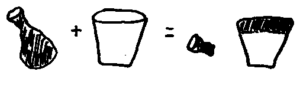
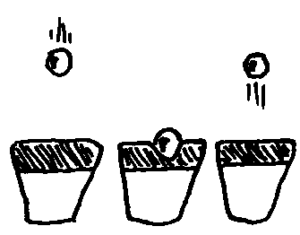
Place a sturdy, undamaged drinking glass on a stable surface inside a tray. Carefully cut the neck off a balloon, then stretch the remaining rubber over the rim. Release a small marble from a short distance above the center and observe its bounces. Children should have adult help with the scissors and glass, and small parts should be kept away from young children. What happens to the height of successive bounces, and why?
Facts
During each bounce, the ball pushes the membrane downward and then rises again. Some of its energy is temporarily stored in the deformed membrane and, if the trapped air is compressed, in the air beneath it. Some energy returns to the ball; some is dispersed into internal motion, sound, and motion of the surrounding apparatus.
The height reached after a bounce gives us a way to compare how much energy returns to the ball. If it rises almost to its previous height, most of that gravitational potential energy has been recovered. The behavior depends on the ball, the membrane’s tension, the seal, and the rest of the setup, so observation should come before a claim about how long it will bounce.
Thoughts and Opinions
The trapped air gives us another part of the system to investigate. When the membrane moves, the volume available to the air can change, affecting its pressure and temperature. How much does that contribute to the bounce compared with the elasticity of the rubber?
If compression and expansion happen quickly enough that little heat passes between the air and its surroundings during contact, we can approximate that part of the motion as adiabatic. That means little heat transfer, not no energy transfer: the air can still receive energy or return it by doing work on the moving membrane. The approximation alone does not show that the whole bounce is nearly lossless.
In an ideal model with no dissipation or other energy left behind in the apparatus, the ball could return to the same height on every bounce. A real setup lets us observe what departs from that ideal.
This is a small experiment with several things to notice. Begin with a low, centered drop. If the ball keeps bouncing off to one side, set it aside and check that the glass is level and the membrane is evenly stretched. Change one feature at a time, then compare the bounces. What changes, and what stays much the same?
I want to share this exercise because it is fun and it is beautiful. For me, it helps my imagination visualize what would happen if a ball could bounce forever.
Forever, eternity, and infinity are allowed in this place.