Exercise
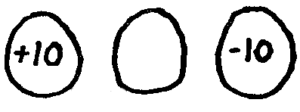
You have three identical conducting spheres. Name the sphere initially charged to +10 P, the sphere initially charged to −10 M, and the initially neutral sphere U₁. These names stay with the spheres even when their charges change sign. All charge values use the same arbitrary unit.
For this idealized puzzle, one operation consists of touching exactly two spheres, allowing their charges to equalize, and separating them again. If their charges before contact are x and y, each has charge (x + y)/2 afterward. Assume the other spheres do not affect this equal-sharing rule. No charge enters or leaves the collection, there is no connection to ground, and only one pair is touched at a time.
You may choose any pair for an operation and reuse spheres any number of times. In each finite version of the puzzle, the number of spheres is fixed at the start; you cannot reset their charges or introduce fresh spheres midway through. With additional spheres, call them U₂, U₃, and so on, and start each of them at zero charge.
Our first goal is to make P negative and M positive. Can you find a sequence of contacts that reverses both signs? Then compare the pairs of final charges you can reach. When comparing outcomes, we will need to decide whether “better” means a larger reversal on P, a larger reversal on M, or some measure involving both.
What becomes possible with a second initially neutral sphere? What happens to a chosen procedure’s results as the number of initially neutral spheres grows? Here we are comparing final net charges, not adding up all the charge moved during repeated contacts.
Facts
Here is one procedure, beginning with at least one initially neutral sphere. Let there be k such spheres, U₁ through Uₖ, so the total number of spheres is N = k + 2.
First, touch P to U₁, then P to U₂, and continue until P has touched each initially neutral sphere once. Next, touch P to M. Finally, touch M to the auxiliary spheres in reverse order: Uₖ, then Uₖ₋₁, continuing back to U₁. Separate the touched pair after every operation.
With three spheres, the contacts are P–U₁, P–M, and M–U₁. In the order (P, M, U₁), the charges change from (+10, −10, 0) to (+5, −10, +5), then (−2.5, −2.5, +5), and finally (−2.5, +1.25, +1.25). Both original spheres have reversed sign.
With four spheres, the contacts are P–U₁, P–U₂, P–M, M–U₂, and M–U₁. The final charges, in the order (P, M, U₁, U₂), are (−3.75, +2.1875, +2.1875, −0.625).
The procedure uses k contacts in the first stage, one between P and M, and k in the final stage: 2k + 1 = 2N − 3 operations. This counts the operations in this procedure; it does not establish that no other procedure could achieve a chosen result in fewer operations.
After the first stage, P has charge 10/2^k, and each Uᵢ has charge 10/2^i. After the P–M contact, P and M each have charge −5 + 5/2^k. P is not touched again. During the reverse sweep, M’s charge q is replaced at each step by (q + 10/2^i)/2, taking i from k down to 1. Applying that recurrence gives the final charge of M as 10/3 − 5/2^k + 5/(3 × 4^k).
As k grows, the powers-of-two terms approach zero. For this procedure, P therefore approaches −5 and M approaches +10/3, or +3.333…. These are limits of a sequence of finite constructions, not charges attained by completing infinitely many contacts. The formulas describe this procedure’s outcomes; whether another procedure does better depends on how we define “better.”
Thoughts and Opinions
This exercise is dedicated to the class of 2023, especially Matt and Mike. Thank you for your hard work helping put this one together.
Charge can redistribute between conducting objects when they touch. For this puzzle, we have represented that process by an exact averaging rule. The identical-sphere, isolated-pair idealization makes the rule simple enough to explore step by step. The diagram below shows the three-sphere example, with P on the left, U₁ in the middle, and M on the right.
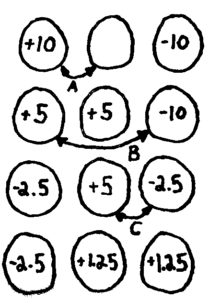
The letters A, B, and C in the diagram label the three operations, not the spheres. Operation A touches P to U₁, operation B touches P to M, and operation C touches M to U₁. Each line gives a new state that can be checked using the averaging rule. The drawing demonstrates a reachable outcome; it does not by itself prove that the outcome is best.
The four-sphere sequence is listed above so that the next case can be checked without another drawing. The five-sphere case is another opportunity to follow the charges by hand. Comparing those cases with the formulas is one way to connect the construction to its limiting behavior.
Matt found a general rule in our original work, which I called the “zipper method.” I also wrote a computer program to explore cases with 4, 5, 6, and eventually 1,000 spheres. Numerical experiments helped reveal the pattern; the stated rules and recurrence let us examine why this particular pattern continues.
The auxiliary spheres finish with charges of their own. Calling that charge “waste” would depend on what we wanted the collection to do. Every contact preserves the total net charge, which began at zero.
There are other ways to compare outcomes. For example, reversing the roles of P and M in the three-sphere procedure produces P = −1.25 and M = +2.5, instead of P = −2.5 and M = +1.25. One result reverses P more strongly; the other reverses M more strongly.
Which question would you like to pursue: the largest reversal on one chosen sphere, the largest combined reversal when both signs have changed, or the strongest equal reversal on the two original spheres? Once the goal is fixed, we can ask whether another sequence improves on this construction, whether a best result is attained or only approached, and how many contacts are needed to reach it.
Changing the sizes of the spheres would also change the charge-sharing model. That could become another puzzle, after specifying the new rule.
Feel free to email me with your thoughts and opinions and any further insights on this matter at [email protected].