Exercise
This is the Forbidden Triangle:
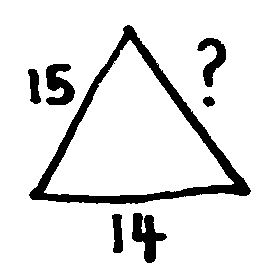
Two sides have lengths 15 and 14. No exact angle is specified, but no two angles are equal, and none of the three angles is 30, 60, or 90 degrees. What can we say about the missing side? Could we choose a length and build a triangle that satisfies these conditions?
Facts
If the missing side has length x, the triangle inequality requires 1 < x < 29. The angle conditions exclude some lengths inside that interval as well. For example, x cannot be 14 or 15, because either choice would give two equal sides and therefore two equal angles. The information still allows many triangles.
At the endpoints, lengths 1 and 29 would produce flattened arrangements rather than triangles with area. The sketch is not a scale measurement that establishes one exact missing length. There is, however, a particular construction I would like to explore: one whose missing side is 13.
Thoughts and opinions
The Forbidden Triangle is one of my favorite geometrical ideas. The general answer describes a range of possibilities. We could stop there, or ask a different question: which possibility would we like to build?
I use “most-right” here as a personal name for an answer that fits a purpose and feels satisfying to build. It does not mean that the other valid answers become incorrect. What makes 13 worth choosing? I would like to approach that question with a few sticks and a tent.
Consider a simpler triangle:
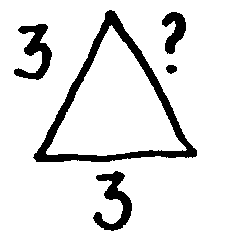
In this sketch, the angles are all equal, so the sides must be equal too. With the given side lengths of 3, the missing side is also 3.
Three ideal sticks of equal length form an equilateral triangle, with angles of 60 degrees. Real sticks and measurements introduce small imperfections, but the model gives us something to build toward. Making the triangle offers another way to become acquainted with the relationship.
Consider another triangle. This one is taught extensively in schools:
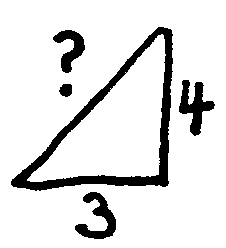
Some readers will recognize the 3–4–5 triangle. Here we specify that the sides of lengths 3 and 4 meet at a right angle. The missing side is then 5, since 3² + 4² = 5². That longest side is called the hypotenuse. With ideal sticks of these lengths, the numerical relationship becomes a construction we can picture and build.
These sketches stand in for the physical act of laying out sticks. I enjoy moving between the drawing, the numbers, and the thing I might build. A construction can be useful, and it can also be beautiful. Different builders may find different possibilities worth pursuing.
Consider this next triangle:
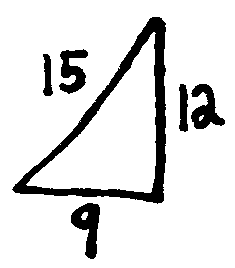
Each side of this triangle is three times as long as the corresponding side of the 3–4–5 triangle. Imagine it as one half of a tent’s cross-section: a vertical support 12 feet high, a horizontal base extending 9 feet to one side, and a sloping edge 15 feet long. The sketch gives the frame’s geometry; fabric coverage and weatherproofing would be separate practical questions. This is a very big tent, but I have very big needs for shelter and safety.
The other half of my tent does not have to match the first. Here is another right triangle that can share the same 12-foot support:
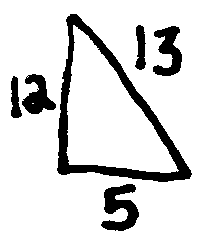
With a height of 12 feet and a horizontal base of 5 feet, the sloping edge is 13 feet, since 5² + 12² = 13². I find this choice beautiful. It gives the tent two different halves that meet at the same height.
There are other choices we could make. What might lead someone to prefer one construction over another: symmetry, available materials, room inside, or simply the pleasure of how the pieces fit?
Finish building my tent by placing the two right triangles on opposite sides of their shared 12-foot support. The base is 9 + 5 = 14 feet, and the outer slopes are 15 and 13 feet. The result is a 13–14–15 triangle whose angles are all different and none of which is 30, 60, or 90 degrees.
That is the construction behind my choice of 13. The opening conditions allow other answers. What might another choice let you build?
Feel free to email me with your thoughts and opinions on this matter at [email protected].
The article above is dedicated to Eric and Will. Thank you for your patience and thoughtful discussions.