Two people share three minutes. Suppose every living human being could share exactly one such moment with every other living human being. How long would it take?
There is no need to decide what makes a moment meaningful. A conversation, a game, a quiet observation, a shared experiment: that question belongs to the people who meet. First, let’s ask what the clock might say.
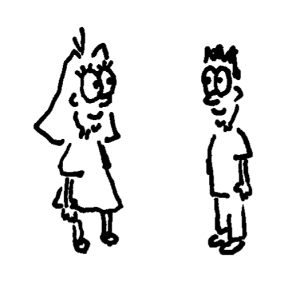
Exercise
Imagine a tournament for everyone alive. In each round, every person is paired with one other person. A pair meets only once, and after three minutes everyone changes partners. No travel, no waiting, no missed appointments. The entire tournament runs day and night.
How many meetings must occur? How many rounds will it take? And how many years will pass before everyone has met everyone else?
Assumptions
- Everyone in the model is alive at the start and remains in it until the end.
- Everyone agrees to participate and can do so; no meeting is forced.
- Meetings happen in pairs, all at once, for exactly the same duration.
- There is no travel or time lost changing partners, and meetings continue around the clock.
- “Sharing a moment” is deliberately left for people to interpret; the arithmetic counts pairings, not emotions.
Change an assumption, and a different question appears. A perfect solution to the arithmetic is not a perfect solution to the human problem.
Facts
To work with a definite number, let’s use an illustrative population of 8,325,980,068 people, near the world population in late 2026. The exact number changes continuously. We will deliberately freeze it for this thought experiment.
|
8,325,980,068 People in our example |
34,660,972,042,203,652,278 Different two-person partnerships |
Each person could meet 8,325,980,067 others. If we multiply those two numbers, we count every meeting twice: once from each person’s side. Divide by two and we have the number of distinct pairs.
pairs = people × (people − 1) ÷ 2
There are an even number of people in this example, so every person can have a partner in every round. Every round accounts for 4,162,990,034 simultaneous meetings. And there is a construction that makes every pair meet exactly once in 8,325,980,067 rounds. No search through trillions of possibilities is necessary.
|
47,491 years Approximately, for three-minute moments, continuously, with instantaneous partner changes. |
That is the result under our assumptions. The arithmetic is simple even if the number is not.
How long is a moment?
Suppose every living person could share
Calculating…
For everyone to meet everyone else.
Based on approximately 8.326 billion people, |
How can we know the schedule exists?
Picture one person standing still while everyone else changes places around a circle. Each round pairs opposite positions. After enough rotations, every possible pair has met once. Tournament organizers call this a round-robin arrangement. For two-person groups, the construction works for any group size; with an odd number, one person rests each round.
With billions of people, the same mathematical idea still works. We do not need to print all 34.7 quintillion pairings to know that an exact schedule can be generated.
The larger social golfer problem considers groups of three, four, or more, where efficient arrangements can become much harder. Ed Pegg Jr.'s Golf Tournaments is an interesting place to explore those constructions.
Thoughts and opinions
The number is rather large. But what should we make of it?
This calculation does not demand that anyone meet anyone else. It says nothing about whether a meeting should happen, whether the people would enjoy it, or what they might discover together. All of those questions matter. Consent, circumstance, time, distance, and individual choice are real.
A mathematical schedule can create opportunities. It cannot guarantee that a meaningful moment takes place.
For the For All idea, that distinction is essential. Sharing moments with all may never be attained, but making room for more of them is a worthy direction. The clock isn't a deadline. It is a question we can revisit as we think about how people learn, create, play, and live together.
What would happen if everyone could share just one moment with someone they had never met? What would we do with those three minutes? Would the next meeting be different because of the first?
And if the number is 47,491 years under nearly impossible conditions, perhaps the moments available to us now deserve some thought.
More thoughts and opinions: Historical Moments
The reader may be interested in the history of some moments. A medieval moment has been said to span the length of 90 modern seconds.
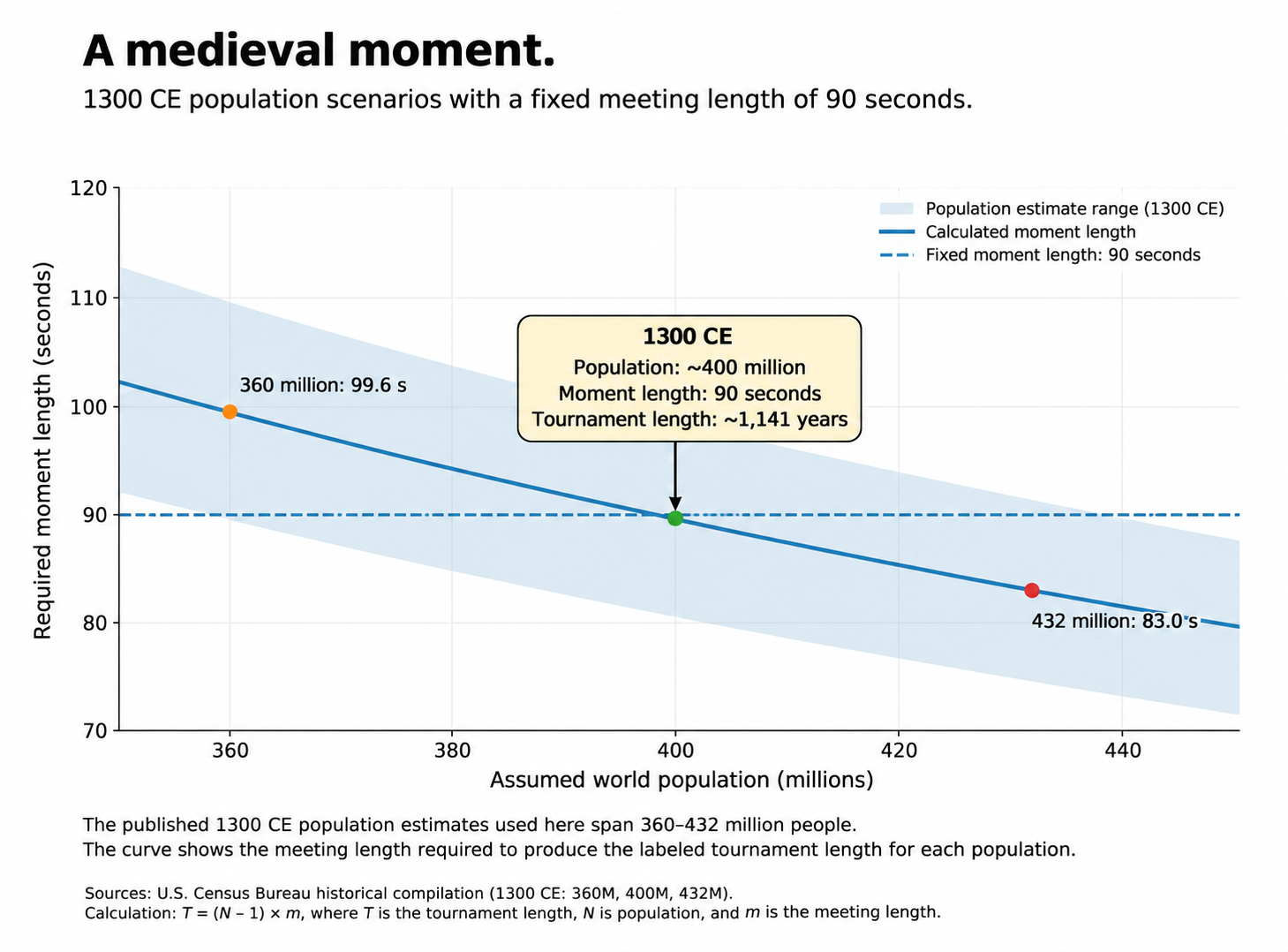
This idea coincides roughly at a time where humanity was numbered in roughly a little less than half a billion individuals at the time of Dante Alighieri who authored The Divine Comedy around this period. The tournament time required to share one 90 second moment in the way prescribed with all individuals would take roughly 1,100 years to complete. I do not assume any divine connections, but there's nothing wrong with a little creative exploration in time. I have chosen to preserve this graph, though imperfect, because I believe process matters and communicating that process, though risky, may really pay off. I just like the curve!
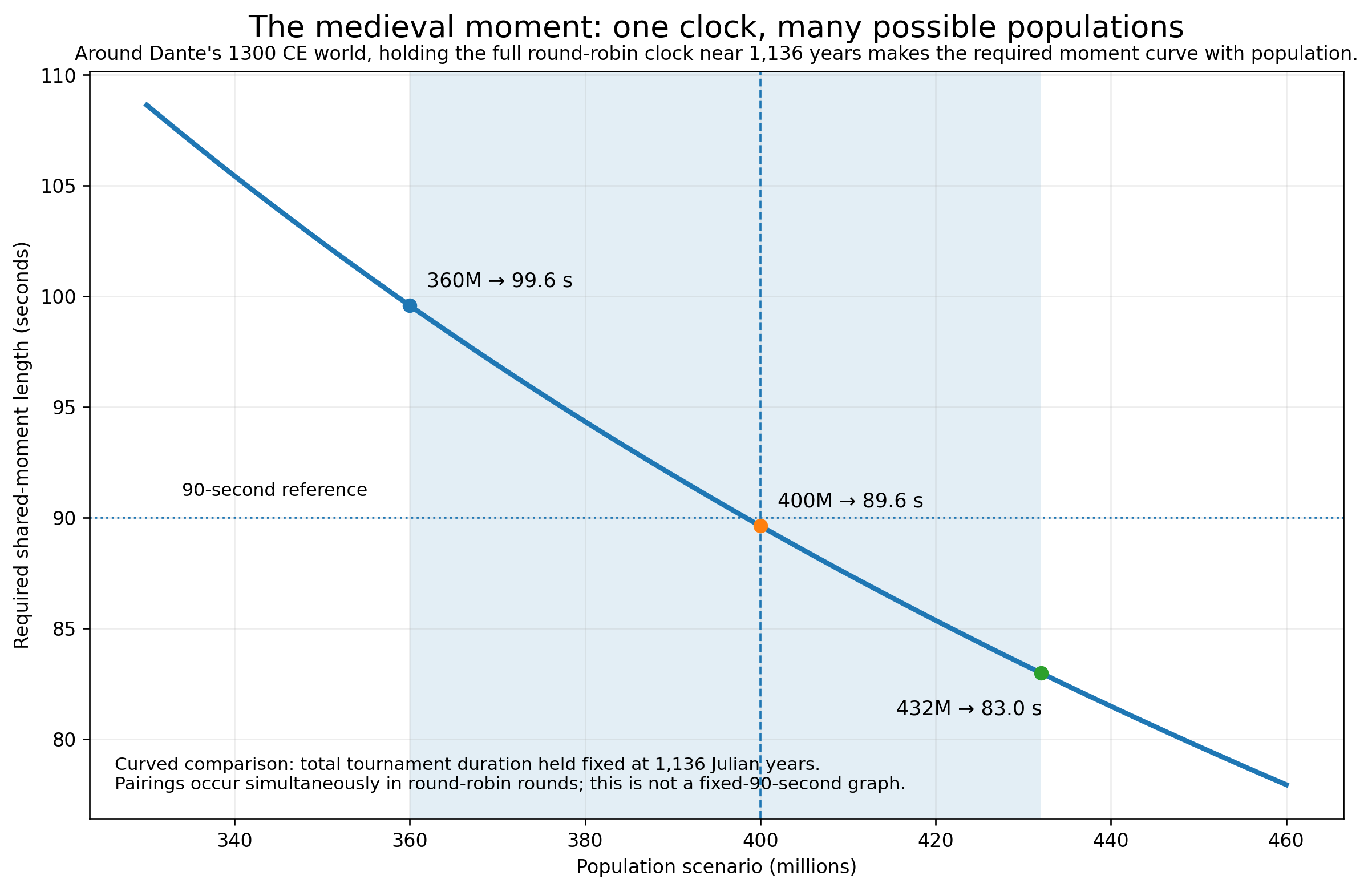
In this next iteration of refinement on the idea, we hold the full tournament time steady and asks how long each shared moment would need to be as the population changes. That is why the line bends: more people require shorter individual moments if the whole journey is to finish in the same amount of time. I have chosen to preserve this graph as an illustration on the process I have used to help illuminate thinking on moments. I wouldn't have gotten here without the curves.
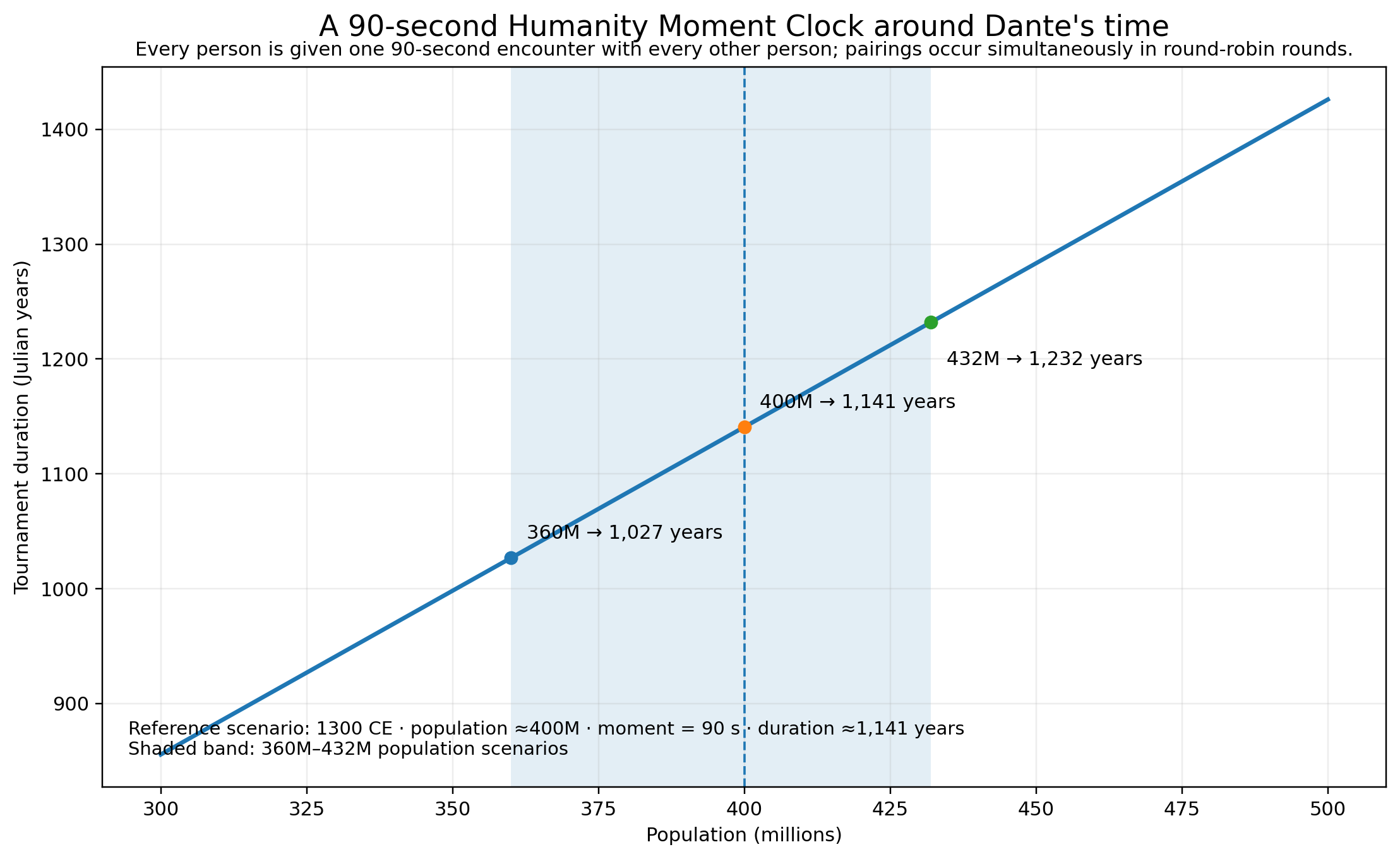
The straight graph turns the question around. It holds the shared moment steady at 90 seconds and asks how long the full tournament would take as the population changes. With the moment fixed, each additional round simply adds another 90 seconds, so the relationship is nearly a straight line. No, I do not find that boring exactly or less beautiful, but as a part of this process it belongs at the end. Very precise, but lacking its curves.
Neither graph corrects the other. They are two views of the same round-robin relationship, each holding a different part of the recipe constant. The curve asks, “What kind of moment preserves this span of time?” The straight line asks, “What span of time follows from preserving this kind of moment?”
Around Dante’s world, those two questions happen to meet very closely: a population near 400 million, a moment near 90 seconds, and a total clock a little over eleven centuries long.
First posed November 11, 2026. Population input is a rounded illustrative scenario, not an official headcount. 3 minutes rocks because music is Beautiful. Related mathematical reading: Ed Pegg Jr., “Golf Tournaments” (2007).